
Author
Tessa Stoppelenburg
Date
April 2026
Category
Regulations
2026 will be an important year for e-commerce with the introduction of ESPR legislation. In order to reduce the environmental impact of e-commerce, the EU has created a number of new rules with which online stores must comply. Including the Digital Product Passport, the Withdrawal button, the Right to Repair and the new Packaging and Packaging Waste Regulation. These EU regulations will affect all processes within e-commerce, including the returns process.
In this blog you can read what the EU regulations on returns entail and how to prepare your webshop and returns process for them. At the end you will find a checklist to check if your webshop is compliant for the upcoming Withdrawal button regulation.
In this blog, you'll read more about...
1. Why 2026 is a turning point for e-commerce returns.
2. Impact of ESPR on the returns process.
3. Overview: four key regulations affecting your returns process.
4. Digital Product Passport.
5. The Withdrawal button.
6. Right to Repair.
7. Packaging and Packaging Waste Regulation.
Why 2026 is a turning point for e-commerce returns.
On July 18, 2024, the EU adopted the Ecodesign for Sustainable Products Regulation, ESPR for short, to make e-commerce more sustainable. The regulation is part of the broader European Green Deal and Circular Economy Action Plan, through which the EU is committed to sustainability, a circular economy and consumer protection. And this is much needed; e-commerce has a huge impact on the environment. In our report, The State of Returns 2026, you can read that as much as €53.5 billion of goods were wasted in 2025.
ESPR regulations are going to be introduced in all member states of Europe in the next few years. This means that all products sold within the EU must meet the established requirements. Non-compliance with the new regulations can lead to warnings and ultimately to a sales ban on the EU market. In addition to the organizational challenges, however, the new regulation also offers advantages for webshops: more and more consumers are actively including a contribution to a better environment in their purchasing decision. The legislation also encourages them to look critically at how to proactively prevent returns, which is positive for their sales.
Impact of ESPR on the return process.
The ESPR encourages companies to make both their processes and products more sustainable. This includes making return processes more environmentally friendly and taking targeted measures to reduce the number of returns. Detailed return data is becoming increasingly important in this regard. By analyzing why products are returned, you can prevent similar returns in the future, for example by improving product descriptions or removing products from the assortment. In addition, the Digital Product Passport provides more transparency towards consumers, which leads to fewer mis-purchases and thus fewer returns.
Overview: four key regulations affecting your returns process.
|
Regulations |
Start date |
Applicable to |
| Digital Product Passport | Incremental from 2026. | Depending on product category. Eventually mandatory for all webshops selling in the EU. |
| Withdrawal button | June 19, 2026 | All webshops selling in the EU. |
| Right to Repair | July 31, 2026 | Household appliances and electronics ordered after start date. |
|
PPWR
|
August 12, 2026 | All EU webshops |
For a complete overview and additional information on each regulation, consult the Thuiswinkel.org legislative agenda.
Digital Product Passport: product lifecycle transparency.
The Digital Product Passport will be phased in from 2026 for each product category and will contain all information about the production and processing of the product. Eventually, all products sold on the EU market must have a product passport.
What is the Digital Product Passport?
The Digital Product Passport, also known as DPP, includes all relevant information for the life cycle and sustainability of a product. Through a QR code linked to the GTIN (unique identifier for each product), consumers see all technical features and product-specific data. The DPP contains detailed information about what the product is made of, where it comes from and how it can be used, disposed of, reused or recycled.
Example: Check out the example of our client Studio Anneloes, who has already created a Digital Product Passport for their fashion products using the QR code powered by GS1.
Impact on the return process
The DPP aims to create a more transparent product lifecycle of all products on the EU market. The Digital Product Passport contains detailed information about the product and all parts, which reduces the chance of mis-purchases and makes repair options immediately clear. As a result, returns can be resolved more often with a repair or refurbishment.
The timeline
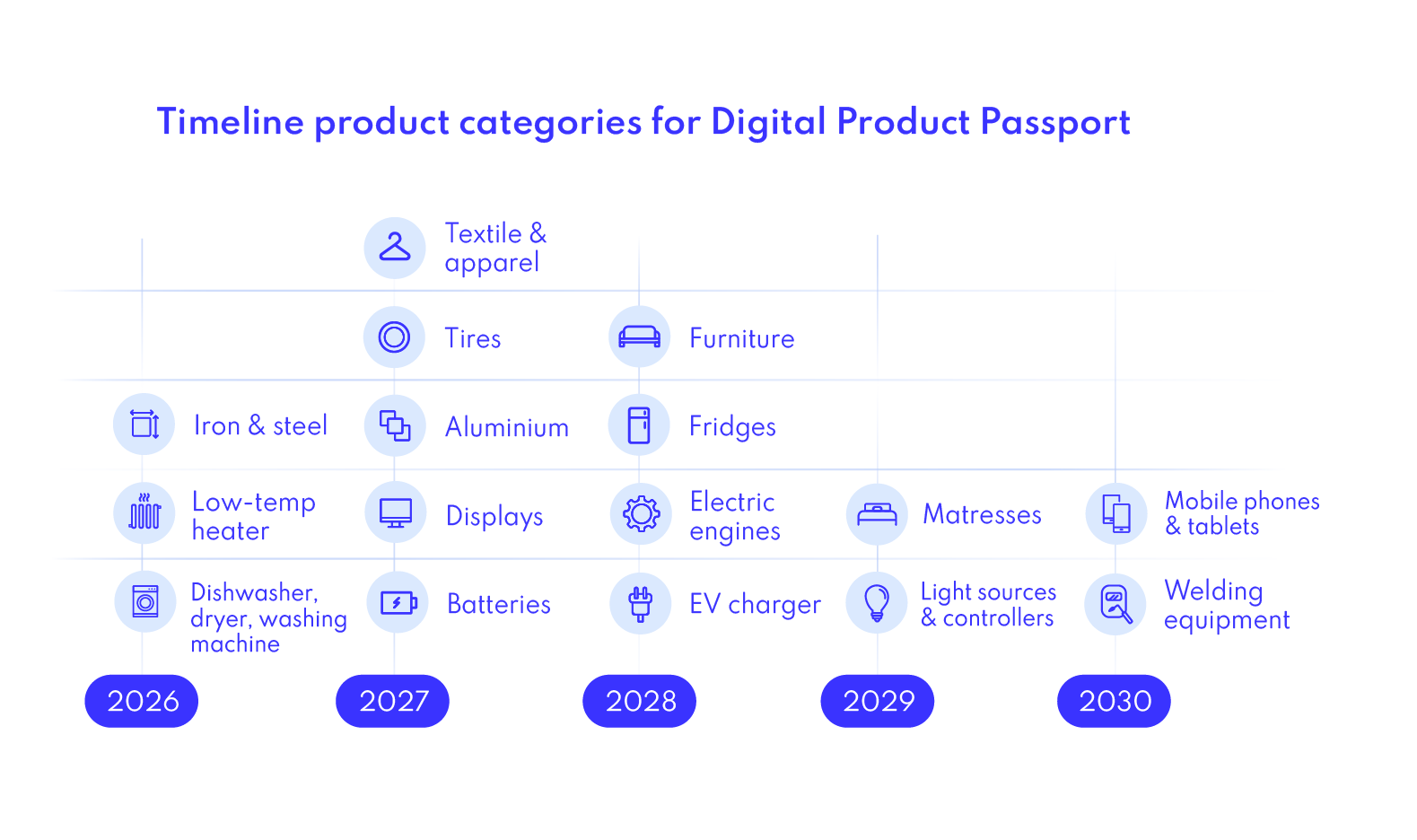
The first obligations within the ESPR regulations will apply to batteries as early as February 2025, in line with the EU Battery Regulation. Other product categories, such as textiles, electronic appliances, furniture and building materials, will follow step by step over the next few years until 2030. Because the EU is rolling out the directives in phases, a final timeline for each category is not yet available. Below, however, is an expected roadmap:
The Withdrawal button: make canceling just as easy as ordering.
Starting June 19, 2026, online stores must offer a visible and easily accessible revocation button on their website that allows consumers to easily cancel their order within the legal revocation period. The goal is to make withdrawal as simple as placing the order, without detours through customer service, emails or other barriers. This withdrawal button should be available not only on the website, but also through the order confirmation and remain accessible throughout the entire 14-day withdrawal period.
Good to know: nothing will change about the right of withdrawal itself. A consumer must still be able to return a received product. If you do not comply with the required right of withdrawal or revocation button, the return period for the consumer is automatically extended to 12 months.
Want to know more about the mandatory revocation feature and how to prepare for it? Find out everything you need to know here.
Prepare your webshop: EU Withdrawal button checklist.
Do you want to get started with the implementation of the ESPR regulations for e-commerce and the return rules for 2026? Download our Withdrawal button checklist and easily check your compliance with the new regulations.
Right to Repair: extending product life with repairs.
On March 22, 2023, the European Commission published a proposal for the Right to Repair. On July 31, 2026, it will enter into force for household appliances and electronics. The goal is to keep products in use longer by encouraging repairs to extend their life.
What does Right to Repair mean?
In today's consumer society, consumers are quick to purchase a new product when something is broken. The Right to Repair aims to counteract this and extend the life of consumer products by repairing and reusing more goods both inside and outside the legal warranty. Repair is encouraged as a valid alternative to a refund and/or replacement of a returned product.
Manufacturers of household appliances and electronics such as refrigerators and smartphones will have to comply with Right to Repair from July 31, 2026. This includes:
- Products must be repairable within a reasonable time and at a reasonable price when repair is as expensive or cheaper than replacement.
- Manufacturers must not circumvent the Right to Repair through contractual clauses and must provide consumers with transparent information about repair options and associated costs. It should also be possible for consumers to have products repaired by another repair service without affecting the manufacturer's repair obligation.
- Is a repair not possible? Then you may alternatively offer consumers a refurbished product for replacement.
- After a repair within the first two years of purchase, the legal warranty period is extended for another 12 months.
For online stores, this means that they must have sufficient parts and tools available to repair products. And that they must adjust their website information and return process accordingly. Indeed, they must inform consumers about the right to repair or replacement and the applicable warranty periods.
What does this mean for returns?
The regulations surrounding Right to Repair require smart integration of repairs into operational processes. The simplest way is to integrate repairs directly into your return process, for example by adding the return reason "defective" in your return form. This makes it easy for consumers to choose repairs when they make a return and allows you to return products directly to the correct repair address. In addition, you make it easier to resell returned products and set up efficient refurbishment and resale processes, for example by offering second-chance products on your website.
In short: With a smart approach to handling returns, Right to Repair actually offers webshops excellent opportunities to reduce returns and save costs.
Packaging and Packaging Waste Regulation (PPWR).
On Feb. 27, 2023, the European Commission published a proposal for a new Packaging and Packaging Waste Regulation, or PPWR for short. It will enter into force for all EU webshops from Aug. 12, 2026. The aim is to significantly reduce the use of packaging materials, improve recycling and prohibit the destruction of unsold consumer products.
What is the Packaging and Packaging Waste Regulation (PPWR)?
It's a recognizable scenario: you order a product and the next day a huge box arrives on your doorstep. To your surprise, after opening it, you find that as much as 90% of the contents consist of packaging material or empty space. This is exactly what the PPWR is intended to prevent. For example, from 2030 the proportion of empty space may not exceed 50%. Also double walls, false bottoms and unnecessary packaging layers are no longer allowed.
In addition, according to the PPWR, packaging must be fully recyclable and meet design criteria for recycling. Non-food packaging, used among other things to ship e-commerce orders, must consist of at least 40% reusable materials by 2030 and 70% reusable materials by 2040. With these measures, the EU aims to reduce the impact of packaging materials and move closer to the Green Deal's goal of being fully climate neutral by 2050.
What counts as excess packaging?
The PPWR distinguishes between reusable packaging and packaging used for shipping e-commerce orders, among other things. For this category:
- Under the PPWR , packaging must not contain unnecessary empty space above the allowable limit. This means that boxes should not be much larger than the product itself.
- The use of padding material is not permitted when it is the result of oversized packaging.
- Unnecessary packaging layers with no obvious function, as well as false bottoms and double walls, are no longer permitted. For example, these are often used as marketing tricks in sectors such as cosmetics, to make the packaging appear larger than the actual contents.
The timeline
Starting Aug. 12, 2026, the PPWR will be rolled out incrementally. Here are the key milestones:
2026: Webshops must comply with new general packaging rules and optimize packaging materials.
2027: Producers are required to submit UPV (Extended Producer Responsibility) declarations for each packaging category.
2028: A harmonized label with material composition becomes mandatory. Packaging standards are also published.
2029: Universal labels for reusable and refillable packaging become mandatory.
2030: Non-food packaging for transport and delivery must consist of at least 40% reusable packaging by 2030, 70% by 2040. An exception applies to bundled reusable and alcoholic and non-alcoholic beverages. Packaging must also be fully recyclable and meet design criteria for recycling. Only packaging with recyclability class A, B or C may then be placed on the market.
How to stay compliant with Returnless.
If you are active in e-commerce, you need to be compliant with some the ESPR regulations by 2026. Non-compliance can lead to fines and penalties, and in the worst case, you won't be allowed to sell your products in the EU. Fortunately, implementing the new rules doesn't have to be complicated. When it comes to the returns process, with Returnless you'll be ESPR-compliant in no time:
- In the digital return form Returnless automatically retrieves order data and prefills the return form with it. The return request is thus completed within a few clicks and is in compliance with the regulations surrounding the withdrawal function.
- Add the compulsory revocation button (Withdrawal button) with a link to the return form in several places on your website and in the order confirmation. This way the order can be revoked at any time after the order date.
- Easily integrate repair workflows into your returns process. For example, you can also have repairs and warranty cases notified with Returnless' return forms so you can send them to the appropriate repair address and handle them.
- Returnless also gives you the flexibility to offer multiple return outcomes. For example, customers can choose between a refund, exchange, repair or shop credit when they make a return.
FAQ.
Do these regulations apply to my webshop if I only sell within one country?
Yes. If your webshop operates within the EU, these regulations apply to your business, regardless of whether you only sell locally. The regulations are part of EU legislation that applies to all member states. Whether you sell only in the Netherlands, Belgium or other EU countries, you must meet these requirements.
What happens if I am not compliant by the deadline?
Non-compliance can lead to fines, regulatory warnings and legal problems. You also suffer reputational damage from customers who expect transparency and sustainability. The amount of fines varies by regulation and country, but can be substantial. It is wise to start implementation early.
Do I have to comply with all five regulations?
It depends on what products you sell. The Stop Button and Packaging Regulations apply to all EU web shops. The Digital Product Passport will also gradually apply to all product categories. The Right to Repair, on the other hand, only applies to certain product categories. Check the article to see which categories are affected and find out what is relevant to your online store.
Who is responsible for creating the Digital Product Passport?
The manufacturer or importer is primarily responsible for creating the DPP. As a webshop, you are required to make this information available to consumers, for example through a QR code on the product or product page. Work with your suppliers to ensure that you receive the correct DPP data.
Do I have to offer repair services to customers myself?
You should inform customers about repair options and offer them at a reasonable price, but you don't have to do the repairs yourself. Work with outside repair services or refer customers to certified repairers. The European Repair Platform (still under development) will simplify this process.
Does the 12-month warranty extension also apply to products outside the warranty period?
No. The 12-month warranty extension only applies when a customer chooses to repair during the standard 2-year statutory warranty period. If a product is out of warranty, this automatic extension does not apply. However, you are then required to offer repair options at a reasonable cost.
May I still use padding material in my packages?
Padding material is allowed as long as it is functional and does not create unnecessary empty space. The ban focuses on excessive packaging such as double walls, false bottoms or boxes that are far too large for the product. If your packaging is reusable (for returns, for example), more lenient rules apply.
What about returnable packaging?
More flexible rules apply to return packaging designed specifically for reuse. For example, if you offer a return bag or reusable box that customers use to return products, it falls under this exception. This encourages sustainable return logistics.
start for free now.
Take a look and test out all the features for free! Or schedule a demo with one of our colleagues if you prefer more information first.