
Author
Tessa Stoppelenburg
Date
November 2026
Category
Informative
How do European online retailers handle returns in 2026? For the Return Benchmark 2026, we analysed returns from more than 1,500 European online retailers that process their returns through Returnless, between October 2025 and September 2026. These are the 12 return statistics that stand out, and what they mean for your shop.
When do returns peak in europe?
1. Returns peak twice a year. Most online retailers prepare for December. But across all industries, return volume rises twice: from December to January, and again in July. The summer peak is just as high as the winter peak. If you only plan extra capacity for Q4, July catches you off guard.
2. The busiest return week of 2026 starts right after Black Friday. From 30 November to 6 December, European online retailers can expect about a quarter more returns than in an average week. Black Friday orders arrive, customers try them, and a week later they come back. And the peak doesn't stop there. Christmas gifts follow in January, so the busy period lasts two months, not two weeks.
-
prepare.Until 22 NovemberThe quietest weeks of the season. Shipping speeds up, returns stay low.
-
peak.23 November – 3 JanuaryBlack Friday orders come back. The busiest return week is 30 Nov – 6 Dec, then volume dips around Christmas.
-
second wave.JanuaryChristmas gifts come back. Return volume stays above normal for weeks.
Why do customers return online purchases?
3. Size and fit is the most common reason to return. About 3 in 10 returned products come back because of size or fit. In fashion, that's no surprise. But size and fit also leads the average across all industries. Every size-related return starts with doubt on the product page. Clear size advice, fit notes and measurements help customers choose right the first time.
4. More than half of all returns can be influenced before the customer buys. Size and fit and products that don't meet expectations together make up the majority of returns. Both start on the product page, not in the warehouse. Damage and delivery errors are only a small part of the picture. Your return reasons show you which product pages need better photos, descriptions or size advice.
What return policies do European online retailers use?
5. 7 in 10 online retailers enforce their return period with a Return rule. The return period is the foundation of almost every return policy. Other rules, such as excluding sale items or limiting frequent returners, are far less common. Most online retailers are generous about what can come back, as long as it comes back on time.
6. Most online retailers keep their return period at 30 days or less. Yet a longer return period changes less than you'd think: most customers decide within about a week, whatever the deadline. A longer window mainly reassures customers before they buy and leaves room for gift returns. That matters in peak season. A gift bought in November is only unwrapped on 25 December.
Do European online retailers offer free returns?
7. Almost 9 in 10 online retailers offer both free and paid returns. Free or paid is rarely a fixed choice. Most online retailers charge by default and make returns free in specific situations, for example when the product is damaged or when the customer chooses store credit. What's normal also differs per country: in Sweden and Denmark, paying for a return is almost standard, while in the Netherlands large marketplaces push online retailers towards free returns.
8. Free return labels go unused three times as often as paid ones. When returning costs nothing, customers start a return more easily, and more often don't follow through. Free returns lower the threshold to start a return, not only to complete one.
How long does a return take?
9. A returned product is out of stock for about three weeks. Half of that time passes before the customer has even started the return. Once the parcel arrives, warehouse processing is the step where you have the most influence. In peak season, every day you win there is an extra selling day: a returned Black Friday purchase is often only available again in mid-December.
10. 4 in 10 returns are sent without a printer. Customers who return with a QR code hand in their parcel sooner than customers who print a label. They shop from their phone, so they want to return from their phone too. A faster hand-in means a faster restock.
How much of the return process is automated?
11. Automations cut the admin time per return by more than 80%. That's compared with handling returns without returns software, not counting the work in the warehouse. Without software, someone matches every return to its order, enters it in the shop system, refunds by hand and emails a label. With Automations, registering and refunding happen automatically, so your team only handles the exceptions. In peak season, when manual work rises sharply, that difference counts double.
How many returns end in a refund?
12. 9 in 10 returns still end in a refund. Every refund is revenue leaving your shop. Store credit and exchanges keep it in, and customers who return for size or fit are the most willing to accept it: they still want the product, just in another size. Online retailers that build their return process around store credit resolve a much larger share of returns this way.
What these statistics mean for your peak season.
- Plan for two months, not two weeks. The peak runs on average from December through January, and July deserves the same attention.
- Be ready before mid-November. Return policy, Automations and warehouse capacity should be in place before the busiest return week starts.
- Check your holiday return period. Make sure gifts bought in November can still come back after Christmas.
- Make store credit the easy choice. Especially for size and fit returns.
your returns are costing you more than you think.
The Return Benchmark 2026 shows where you stand.
download the benchmark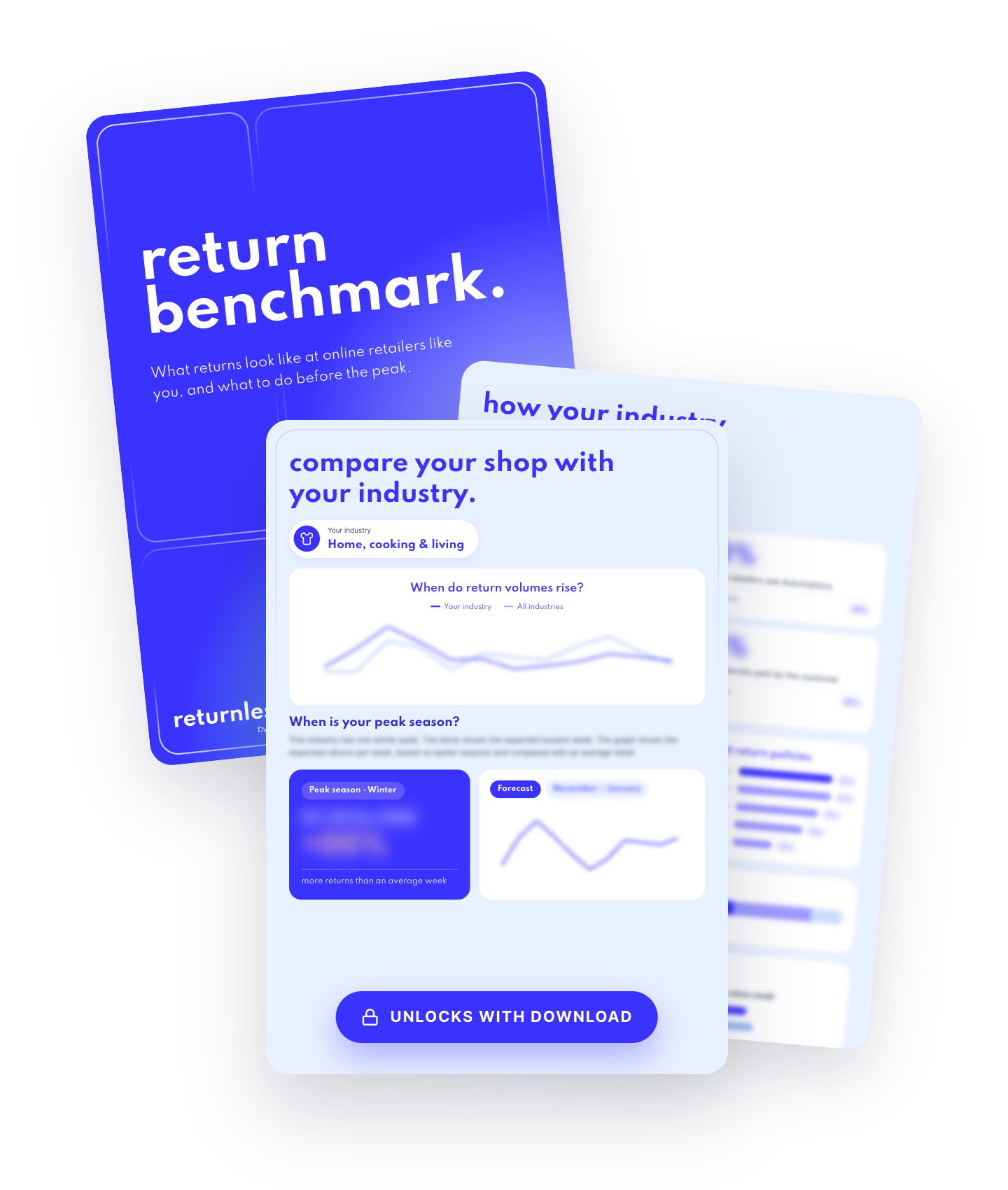
About the data
The statistics in this article come from the Returnless Return Benchmark 2026. They are based on European online retailers that processed returns through Returnless between October 2025 and September 2026. Comparisons with the previous year use October 2024 to September 2025, with the same online retailers active in both periods.
Each online retailer counts equally, so large and small retailers have the same weight. Peak season figures for 2026 are forecasts based on the 2024–2025 and 2025–2026 peak seasons, not final measurements.
When do e-commerce returns peak in Europe?
Returns peak twice a year: from December to January, and in July. The busiest return week of 2026 is expected from 30 November to 6 December, the week after Black Friday.
What is the most common reason for online returns?
Size and fit. About 3 in 10 returned products come back because of size or fit.
What return period do European online retailers use?
Most online retailers keep their return period at 30 days or less, and 7 in 10 enforce it with a Return rule.
How long is a returned product out of stock?
About three weeks, from the order until the product is back in the warehouse.
How many returns end in a refund?
9 in 10 returns end in a refund. The rest are resolved with store credit, such as a coupon or gift card.
get started for free.
Play around and test out all features for free. Or schedule a demo with one of our colleagues if you'd like more info first.